
How to create a strategy?
Management Consultants are extremely good at creating a plethora of strategies, tactics, and frameworks. They all sound interesting but at the very end, you don’t know how to use them and how do they interact with each other. Below is a nice picture showing just a handful of them.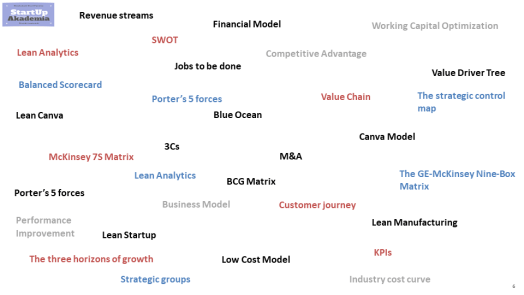
If you want to be a badass consultant, you have to put some order into that sea of frameworks and create an algorithm that, in a sense, will tell you which route to take and what it means for you. Slowly but surel,y we are trying to get there 🙂 . As a first step, we have created a nice 300-slide presentation that shows a simple approach to strategy. Before you move on to the presentatio,n we have prepared a short overview of our approach.
5 routes.
There are basically 5 strategic routes that you can consider as a company:
- Do what you do but better. This is a great option if you are satisfied with the size of the business or, for some reason, you cannot grow it. Here, you concentrate on improving your business, increasing profitability, and generating as much cash as possible. Quite often, it may be a stage before you set out on another of the 5 routes
- Expand. Most people like having more, so the majority will try (and quite often fail) to expand the business. This route is all about scaling the known business in the right way.
- Go niche. Sometimes you have to redefine your business so as not to be crushed by competitors. One of the ways to defend your business is to go niche.
- Transform. If you want to be really big, a pure expansion will not suffice. You will have to gradually transform your business into a new beast. Sometimes you do it to grow faster your current business models. On other occasions, you do it because you have used up all the opportunities to grow, and now you need a new potential to develop further.
- Disrupt yourself. The toughest one is the last one. In this case, you don’t transform your business slowly, but you have to do it radically, killing your revenue streams in the process before somebody does it to you.
We have prepared an extensive presentation describing all the routes in detail: Strategy for Management Consultants. For those who want to have a taste of it without going through the 300 slides, below is a short summary of each and every route.
Do what you do, but better
As we have said, this is a great option if you are satisfied with the size of the business, or for some reason, you cannot grow it. Here, you concentrate on improving your business, increasing profitability, and generating as much cash as possible. Quite often it may be a stage before you set out on to another of the 5 routes. There are plenty of tools and techniques that will help you achieve that. My favorite ones that every badass consultant should master are:
- Essential Lean Manufacturing Techniques and Theory of Constraints. If you want to improve processes, those techniques will be priceless and will greatly help you not only to cut costs and inventory but also improve quality. Many businesses were totally transformed thanks to these methods
- Consulting Techniques. Obviously, consulting techniques and frameworks are great for improving the profitability of the business. They will help you set priorities and estimate what has the biggest potential.
- Examples of improving the supply chain. Even if the business does not grow you can drastically improve the profitability by looking at supply chain issues. Have a look at some main challenges in the supply chain and examples of how to improve the supply chain
- Examples of improving sales & marketing. Another source of potential improvements is sales and marketing. You can try to lower the cost of acquiring and retaining customers, increasing their values, cross-selling their new products, or doing a little bit of up-selling. Have a look at some main challenges in sales & marketing and examples of how to improve the sales & marketing
- Framework for increasing sales of consumer goods. Even if you are happy with your current situation, you should still try to increase your revenues using some of the ways that are in line with your goals and strategy. Let’s look at some of the ways you can consider if you are selling consumer goods:
- Frameworks for cutting costs. Firms have always had problems with the cost side. That’s why if you want to keep your size on the relatively same level, you have to put a lot of effort into keeping your costs in check and becoming more effective. I recommend checking our framework for that:
- Reporting system based on Drivers and KPIs. To be able to improve the firm you have to have a good set of KPIs linked to the real drivers of the business. Check my post on KPIs and how to use them to see how you should create such a system.
Expand
People like to conquer and to have more (even if they don’t know what to do with it 😉 ). Therefore, expanding the business is such an attractive option, and hardly anybody stops at route 1 (doing what you do but better). The expansion has many shades and options: you can enter new geographical markets, you can add products to existing categories, add new categories, target new customer groups, go up or down the value chain, and can, in the end, buy your competitors or even businesses not directly connected with you. As you can see, there are plenty of interesting options and you will never be bored. This is the Golden Mine for consultants, as this is where companies fail a lot and need assistance to be able to scale the business to new markets in the right manner. I recommend some additional reading that you may find interesting:
- Does it make sense to introduce new products – a case study in Excel
- Finding the white spaces in your market
- How to create rankings for potential expansion opportunities
- Expanding via M&A – potential benefits
- Calculating potential benefits of M&M in Excel – case study
Quite good in this sort of approach is Uber. Below is a summary of their business model and how they have been expanding
Go niche
Quite often, expansion is not the right choice as your positioning is making you vulnerable. With the expansion, you are simply scaling the problem. Before the expansion, you should most likely reconsider your positioning and for example, go niche. This is the unfortunate history of many mainstream players that were totally demolished by low-cost players and the application of the blue ocean strategy. Here you have 3 main options: going down the price (low-cost players / no-frill business model), going up with the prices (luxury products), and addressing the neglected segments and non-users (blue ocean strategy). As always, some additional recommended readings:
- Low-cost business model
- Why does it make sense to start in a niche
- Why did Tesla start in a niche?
- Blue Ocean Strategy in a nutshell
- How to start in a niche?
Transform.
If you thought that expansion is difficult, then you will be shocked at how difficult transformation is. If the firm is to live for longer than 10-20 years, it will have to transform its business model at some point and most likely multiple times. If somebody asked me to categorize how difficult it is, I would say that 10x what we saw in the case of expansion. Moreover, in expansion, you see the result fast. In the case of transformation, you are sometimes doing things that will help you stay in business in 10-15 years and will cost millions to build. To give you a taste of what transformation is about, below is a short summary of this route
A great example of a successful (for the time being) transformation of the business model is Netflix. Below is a movie showing the changes made to their business model over the last 20 years:
I recommend, as always, a few other resources:
- What is Amazon?
- How Amazon has scaled its sales
- How was Amazon scaling its business and removing bottlenecks?
- How has Netflix transformed its business?
- How to scale up your operations
- How to grow the organization
- Innovative revenue streams
- How Shopify has been transforming its business model
Disrupt yourself.
The toughest route, and to be honest, requiring you to be a bit of a psychopath, is the route of disruption. In this case, however, you disrupt yourself and in the process, you are kind of killing your business. It is obviously for the greater good and high rewards. Nevertheless, it requires huge psychological resistance to the short-term costs and problems that hardly anybody can master. Below is a short movie that shows you when and why it may make sense
That’s in short about my approach to strategy. For more examples with calculations in Excel, you can find them in my online course, Strategy for Management Consultants & Business Analysts. You will find there not only more examples and resources but also detailed calculations in Excel that will show you how to calculate the impact of your strategy on the revenues and profits of the firm.
Check also my post on Business Model Innovation and How to come up with new business ideas.


The link to the slide deck seems to have been deleted
LikeLike
Hi Aron
Thanks for letting me know.
I updated the link. It should work now.
Take care
A.
LikeLike
I like how this blog post breaks down different strategic approaches in an understandable way.
LikeLike
Hi Ryan,
Thanks a lot for the nice message. It really means a lot to me.
I’m happy to hear that you liked the post.
Have a great day!
All the best.
Asen
LikeLike